

08/07/2025

Real-time Monitoring of a Thiazole Synthesis with low-Field NMR Spectroscopy
Dr. Simon Kern , Dr. Alexander Echtermeyer , S-PACT
Intensified continuous processes represent an appealing concept to produce high value products. They can improve quality, safety, sustainability, and profitability compared to batch processes. To exploit the full potential of a tubular reactor system, real-time monitoring of the reactant concentrations is essential to enable real-time quality control.
Thanks to their compact size, recently developed benchtop instruments are an effective means to bring the benefits of NMR spectroscopy into real-time application. As a process example, the synthesis of a Hantzsch thiazole is demonstrated (Figure 1).
Measurements
1H NMR measurements are conducted in flow using Bruker's Insight MR flow cell in an 80 MHz benchtop NMR system (Fourier 80). A 400 MHz NMR instrument serves as a reference method. A schematic sketch of the experimental setup is depicted in Figure 2.

Fig.1: Reaction Scheme: synthesis of a Hantzsch thiazole

Fig.2: Setup for kinetic flow NMR experiments.
Pretreatment
The NMR data is processed in PEAXACT 6, which supports Bruker 1r files and includes NMR-specific pretreatments such as Fourier transform, automatic phase correction, apodization, zero filling, alignment, and more to ensure clean and consistent spectra for reliable modeling and analysis.
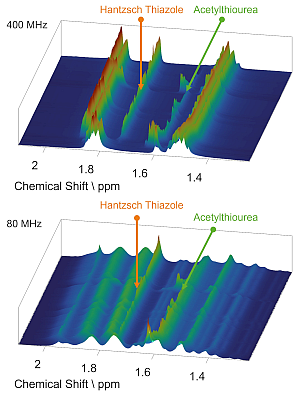
- Fig.3: Aliphatic region of 1H online NMR spectra.
Modeling
The high-field NMR spectra (Figure 3, top) prove that peaks of Acetylthiourea and the Hantzsch thiazole are separate enough to apply peak integration to quantify the components.
However, in low-field spectra the peak resolution is lower and overlaps with the solvent are too pronounced, so that advanced data analysis methods are required (Figure 3, bottom).
Spectral Hard Modeling exploits the physical structure of a spectrum using peak functions, which allows to properly handle peak shifts and shape changes by smart parameter adjustments. Spectral changes induced by, e.g., composition change, molecular interactions, or temperature changes can therefore be handled easily.
A Hard Model for all three reactants and the solvent (NMP) is developed in PEAXACT (Figure 4), making use of both the aromatic and aliphatic signals in the spectrum. The model can now be used to automatically fit unknown spectra and to compute molar fractions of the reactants.

Fig.4: Example of Spectral Hard Models fitted to spectra of a Hantzsch synthesis.
Analysis
NMR spectra from an entire experiment are analyzed via Peak Integration (high-field spectra, HF) and spectral Hard Modeling (low-field spectra, LF). Oscillations in the molar ratios over time originate from fluctuations of the substrate feed and are clearly detected by both methods. Continued variations of the substrate ratio to identify relevant influences on the reaction kinetics can be tracked closely to elucidate dynamics of the synthesis.
Both instruments show excellent agreement despite the different nature of both the spectral data and the analysis approaches. This confirms the value of combining the accuracy of common high-field NMR equipment with the real-time capabilities of low-field benchtop devices.

Fig.5: Quantitative results of low- and high-field NMR instruments.
Summary
The case study shows how low-field NMR spectroscopy boosts the performance of continuous processes by real-time chemical analysis. Especially with respect to automated use in the field, the applied setup easily fulfils all requirements of robustness and reliability.
Spectral Hard Modeling is the preferred approach to translate classical integration of distinct peaks in high-field NMR into an equivalent quantitative analysis of complex overlapping signals from low-field measurements. The interfaces for PEAXACT models in Bruker's TopSpin and synTQ software make all analyses readily applicable for automated real-time predictions.
Acknowledgement:
The authors gratefully thank Vincenzo Fusillo, Matteo Pennestri, and Anna Codina from Bruker BioSpin for the fruitful exchange.